
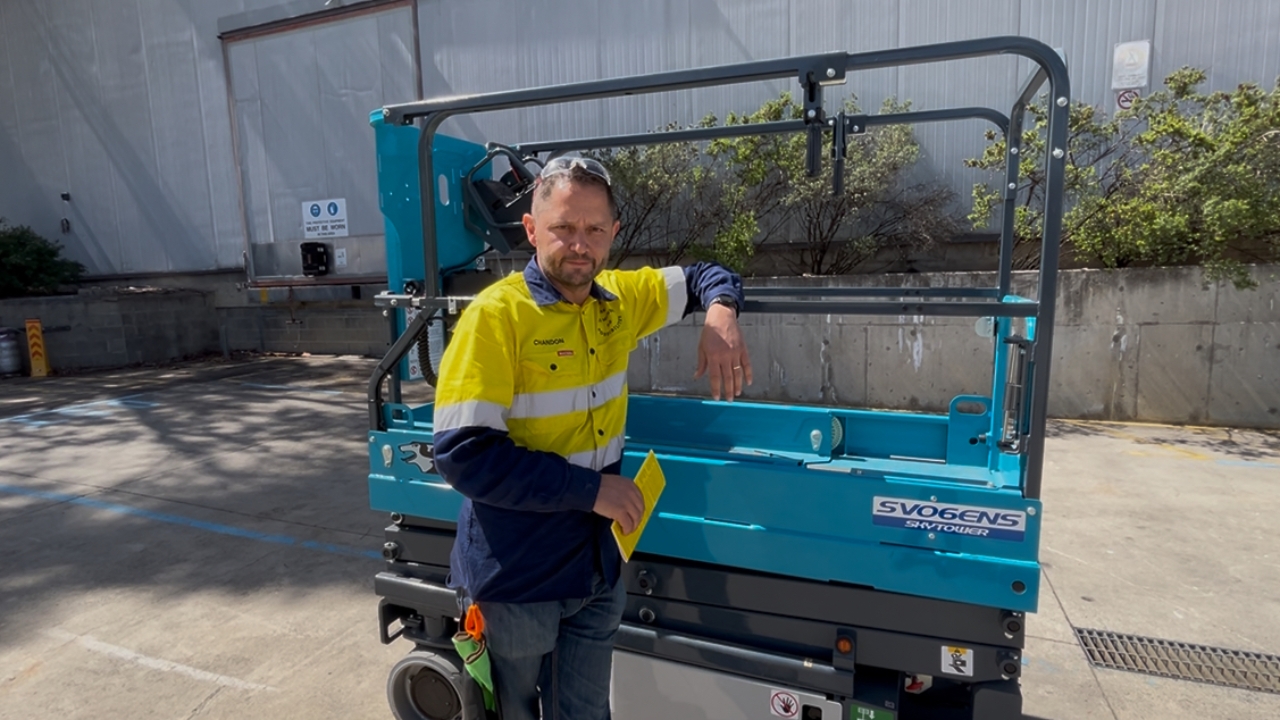
Pre-Operational Essentials
Only competent and authorised persons with appropriate training are permitted to use the scissor lift (EWPA Yellow card class ‘SL’ or equivalent).
Important: A trained and competent spotter may be required for the duration of the EWP use - always check with your site contact.
Work at Heights Permit
Before commencing any safety checks or operating the EWP, it is a requirement to complete a Work at Heights Permit. Contractors are required to obtain this permit through their designated site contact.

Operator Manual
Prior to operation, please familiarise yourself with the EWP's operator manual, which is readily accessible within the cabin. This manual contains crucial information regarding safe operation, emergency procedures, and specifications.

EWP Logbook
Upon issuance of a Work at Heights Permit, pre-start checks can commence. These checks, along with all subsequent machine usage, must be recorded in the EWP Logbook.
EWP Logbook - Operator Details
Section one records operator details. In the next available space, accurately record date, time, your name, signature and your license number.
EWP Logbook - Faults & Problems
Section two is dedicated to documenting any identified faults or problems with the EWP, including if they've been fixed.
Important: If any faults or issues are discovered, the EWP must not be operated. Immediately report to Engineering or site contact.
Pre-Start Safety Check
The next step is to carry out the comprehensive safety checks of the EWP using the checklist located on the front cover of the log book.
Battery Check
Access the battery compartments via the hatches located on both sides of the EWP. Conduct a visual inspection to ensure there are no leaks and that all components are securely in place.
Important: Battery water levels do not require operator attention; this task is exclusively performed by the service technician.
Battery Check Conclusion
After verifying the integrity and proper placement of batteries on both sides of the machine, the charging cable can be disconnected, and the hatches secured.
Move EWP to Open Area
Following the battery inspection, and assuming no faults were identified, position the EWP in an open area. Elevate the entire cabin to facilitate further comprehensive checks.
Pre-Operational Inspection
Conduct a thorough visual walk around of the EWP, checking for the following:
Tires: Inspect for any signs of wear or damage.
Structural Integrity: Verify the absence of any damage, obvious leaks, or anomalies, ensuring all components are in their proper condition.
Batteries: Confirm that all battery compartments are securely locked.
Outer Controls - Location & Function
The EWP's outer controls are located at the base of the unit. These controls facilitate the transfer of operational functions from the cabin to the ground-level panel, as illustrated.
Outer Controls - Key Switch Transfer
When activated, the key switch transfers operational control to the lower control panel.
Outer Controls - Platform Lift Check
Activate both switches on the outer control panel simultaneously to verify proper platform elevation.
Safety Arm Engagement
Immediately after elevating the platform, securely engage the safety arm to prevent unintended descent of the EWP.
Elevated Platform Inspection
With the platform elevated and secured, continue the visual inspection, focusing on:
Lift Arms: Examine for any damage.
Leakage: Check for any obvious fluid leaks, particularly hydraulic oil from hydraulic components.
Cleanliness and Component Integrity: Ensure the unit is clean and free from any visible damage to internal components.
Concluding External Checks
Upon completion of the external visual inspection, disengage the safety arm and secure it in its stowed position.
Returning Platform to Ground Level
To lower the platform, actuate the two switches previously used for elevation. In this sequence, the left switch controls UPWARD movement, and the right switch controls DOWNWARD movement until the platform reaches ground level. Then, return control to the cabin by rotating the key to the left.
Fault Reporting Procedure
Should any discrepancies or issues be identified during the inspection, immediately document these findings in Section Two (Faults & Problems) of the EWP logbook.
Fault Reporting and Remediation
After documenting the fault, the unit must be immediately tagged out of service. Then, report it to Engineering or site contact. A service technician will then be arranged to fix all identified faults before it can be returned to operation.
EWP Safe Operation
Only operate if trained and authorised.
Conduct a pre-start safety check.
Ensure personnel are clear of area before movement.
Assess surface stability, wind speed, and load limits; do not operate in unsafe conditions.
Stay alert to overhead obstructions and hazards.
Barricade the area to restrict access.
Use a competent spotter when required.
Know emergency lowering procedures and control locations.
Report incidents to site contact.