
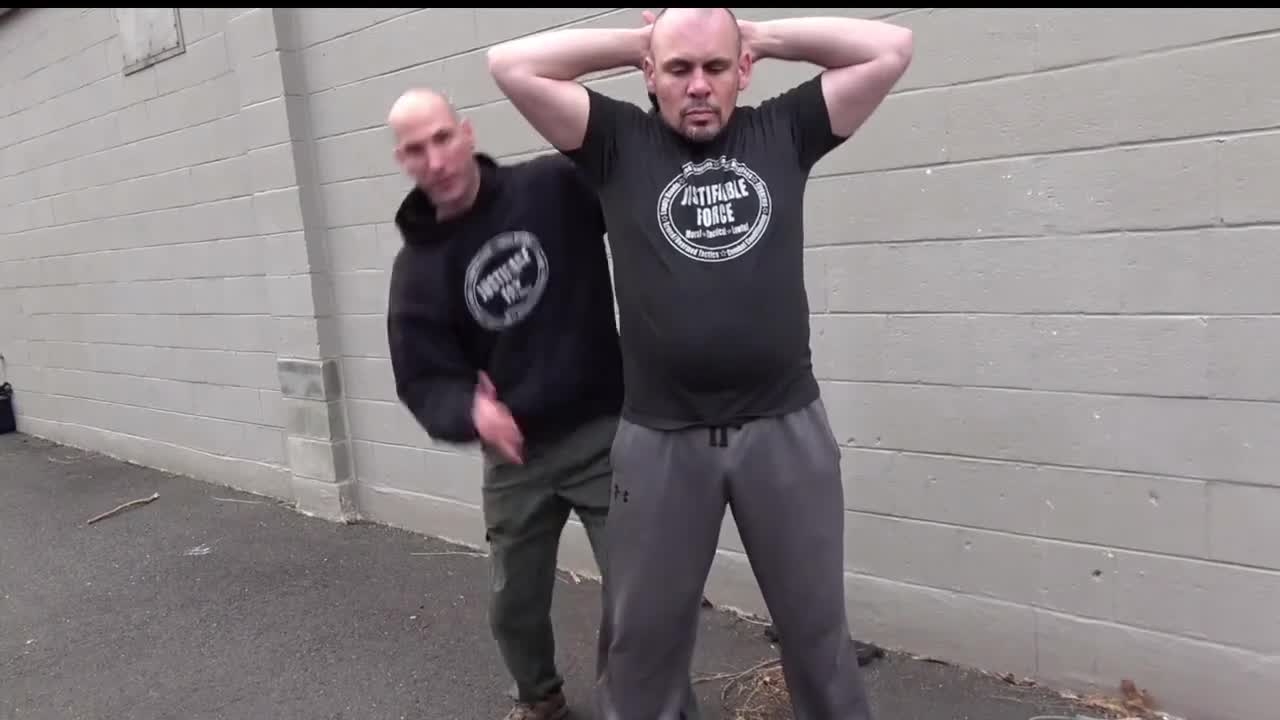
We want to take a visual before we get close enough to go hands on.
And that visual is going to include the hands, waistband, and the face.
And also the face because the eyes are the windows to the soul and they don't lie.
So we can tell a person whether they're going to be agitated, whether they're going to comply, whether they're thinking about something to do.
But in a very instant of a basic search, we want to control the hands.
So, if someone has their hands in their pocket, the first thing we should be doing is controlling the hands.
Use commands.
"Take your hands out of your pocket."
"Let me see your hands clear."
At this point, when taking that visual, I'm once again looking hands, waistband and the face.
When I do that, I'm also going to now turn the person away from me.
"Turn around."
I've taken a visual of the backside.
"Put your arms up to the side."
"Palms facing me."
Once again, I'm taking a visual of the hands from this angle.
"Place your hands on top of your head." "Interlace your fingers."
From here, I am going to make my approach, as he didn’t show any signs of being combative.
At this time, I'm going to secure the hands with my hand.
Grabbing inside, interlaced fingers and dropping my hand down.
Now from here is when I'm going to start to conduct the pat frisk.
"Spread your feet out."
I can see what he is doing even though I'm looking at the waistband.
I don't want to stick my head so far in front of the person where they can grab me.
Depending upon what that person is doing, if they decide to defeat my grip at any time, I can utilize my lower half to effect the takedown.
Or I can use my upper body to effect the takedown from that position.
I want to hit the key clinical areas, which is going to be primarily the waistband.
Upper chest, waistband, inside of thigh and the ankle area and also the small of the back.
Those are the primary areas that I want to hit during the search.
So, during this pat down, if I find something that I believe to be a weapon, what should I do?
I immediately grab onto it, one hand, or onto that weapon, if it's a weapon in the waistband, in the pocket.
So from here, I immediately go securing onto it, or simply two hands controlling the waist, alright? Head is to the back, controlling that waistband.
I don't effect a takedown. Why not?
If I lose control, his arms are free, and his pocket's free, his waistband's free, and now we're all of a sudden fighting for a knife on the ground.
It's more effective to control any type of weapon while it's still in his waistband or in his pocket than it is flailing around in his hand.