
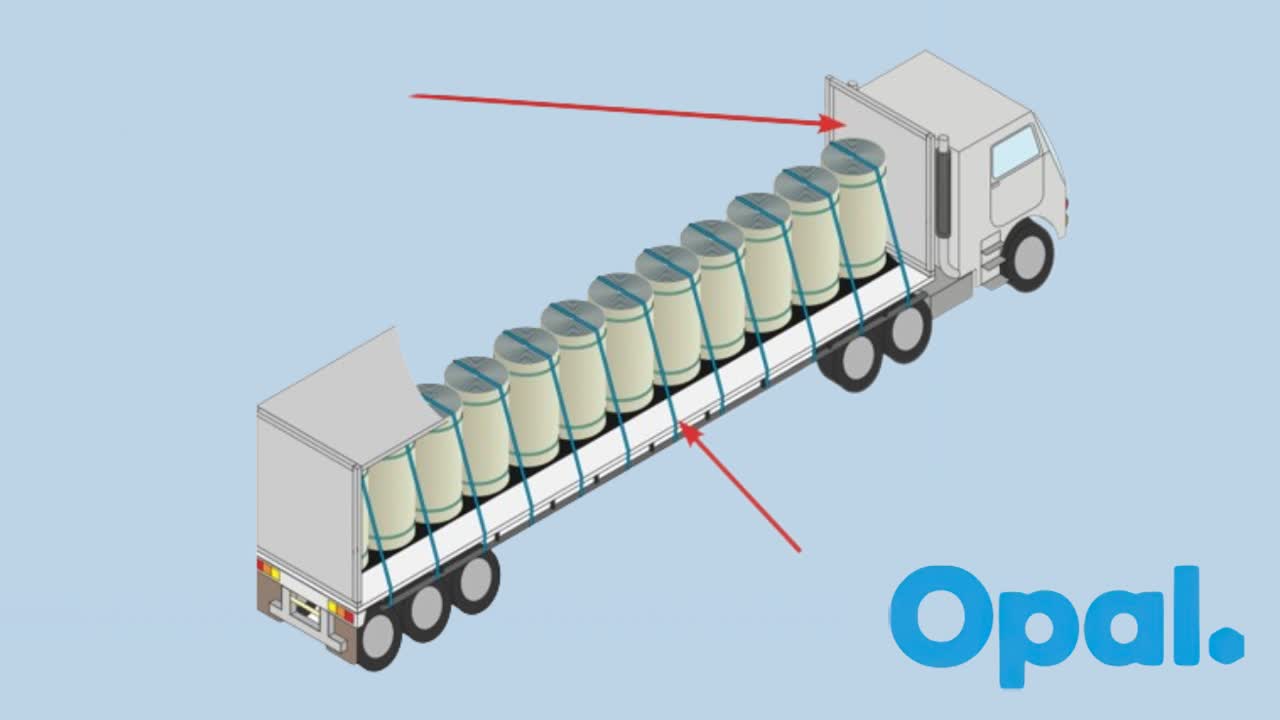

Tie down webbing must be tensioned tight by a long handle reverse action high pretension ratchet.

For staggered loaded reels tie down straps are to be tensioned on the outside edge, unless two straps are applied. For two straps, alternate sides with the straps crossed over the top.
Do not use webbing that is damaged more than 10% of its width. No knots or substantial twists in webbing.
Equipment must be in good working order.

Anti-slip mat must have a friction factor of 0.6 or greater and be clean of any contaminates. Anti-slip matting must cover all contact surfaces of stacked reels.

Decks must be clean and dry. For a load to be considered blocked it must be within 50 mm of the blocking device or an angled forwards lashing is to be used for forwards blocking.
Angled lashing must be at least 750 mm above the deck and at least 2000 mm along the trailer. Angled forwards lashing is to be held in place with specialised approved lashing support (holder lashing).

No gaps between reels in a group.

Stacked reels must be blocked forward by at least half the height of the top reel.

Lashings must be placed on the centre of the reel and be vertical.

Protective angles are required on reels. Only use approved angles on reels.

Reels must be loaded with anti-slip mat or paper/cardboard between the reel to deck. Anti-slip mat can be either in strips or full coverage. Do not load reels on Corflute or other unapproved materials.

If cardboard or paper is used instead of anti- slip mat the required number of straps becomes uneconomical for full mass reels.

Full loads of reels with heights above 2450 mm will reduce the trailer static roll threshold (SRT) below 0.35 g. This greatly increases the chance of the vehicle rolling over.
For trailers with steel spring suspension the SRT is typically worse than air bag suspension. Therefore steel spring suspension is not suitabile.
Extra care should be taken with low SRT loads at roundabouts, freeway on and off ramps, and curves, especially locations with a reverse camber (outward slope). Best practice is reduced payload and/or use of step deck trailers to improve the SRT to 0.35 g.

Maximum of 2 webbing lashings per reel. If reel requires more than 2 it must be loaded or restrained by a different method that allows for a larger mass capacity.

Staggered reels loaded on anti-slip mat maximum weight per High Pretension webbing lashing is 2.5 tonnes. Reels in the rear group must be a single reel not slit. The front reel of the unblocked group with blocking strap must be loaded centre on the deck.
Reels must be placed so that the maximum distance across the outside of adjacent staggered reels is 1.6 times the diameter of the smaller reel. When stacking reels they must be of the same diameter with a maximum of 3 stacked.

If a gap is required between reel groups for axle weight distribution, a forwards blocking lashing is required. This lashing must be a 2500 kg lashing capacity (50 mm wide).

Select the first loop in the holder lashing that is more than 750 mm above the deck and pull the lashing back at least 2000 mm along the trailer.

Maximum of 14.4 tonnes per blocking lashing (If greater than 14.4 tonnes another blocking lashing will be required along the middle of the reel group).

Single file reels loaded on cardboard or directly to deck maximum weight per High Pretension webbing lashing is 2.5 tonnes (i.e. if the reel is under 2.5 tonnes it will require 1 webbing lashing, if over it will require 2 or more lashings).

Single file reels loaded on anti-slip mat maximum weight per High Pretension webbing lashing is 3.6 tonnes.
When stacking reels they must be of the same diameter (±40 mm, 20 mm each side) with a maximum of 3 stacked. At least half the height of the top reel must be blocked forwards and rearwards.

If a gap is required between reel groups for axle weight distribution, a forwards blocking lashing is required. This lashing must be a 2500 kg lashing capacity (50 mm wide).

Select the first loop in the holder lashing that is more than 750 mm above the deck and pull the lashing back at least 2000 mm along the trailer.

Reels must be placed so that the maximum distance across the outside of adjacent staggered reels is 1.6 times the diameter of the smaller reel.

Reel row width cannot exceed that outlined in a table.