
How to make a lemon battery by Ilham Kadri
Here is a longer description
Here is a longer description
1
Step 1 of 45Hello everyone. I am Ilham Kadri, the Chief Executive Officer of Solvay, a science and specialty company.
2
Step 2 of 45I always loved sciences. By the way, I am a chemical engineer and a doctor in polymer chemistry.
3
Step 3 of 45Did you know that chemistry is all around you? Did you know that chemistry can clean the air you breathe, purify the water you drink, produce the alcoholic gels you use to combat diseases like COVID-19? In fact, even our bodies are made out of chemicals.
4
Step 4 of 45Without it, we can't find sustainable solutions to fight climate change, for example, to help preserve our planet, to recycle the used products.
5
Step 5 of 45In fact, chemistry enables circularity.
6
Step 6 of 45I am here today at Solvay's Battery Research and Innovation Centre in Brussels, Belgium.
7
Step 7 of 45This is where we do all of our research on solid-state batteries to invent the batteries of tomorrow.
8
Step 8 of 45As you know, there are batteries everywhere around you, in toys, in cell phones, computers, in cars, and we want them to be safe, long-lasting, powerful and clean.
9
Step 9 of 45So we are in a real lab today, and that's the reason why I'm wearing lab coats, as you can see, and safety goggles.
10
Step 10 of 45And I invite you, if you are running a chemical experiment, you must always wear protective equipment like me, because this is what we are going to do today.
11
Step 11 of 45So why goggles? It's to keep any liquids from an experiment away from you, away from your eyes and hurting you.
12
Step 12 of 45I'm going to do an experiment today with lemon here.
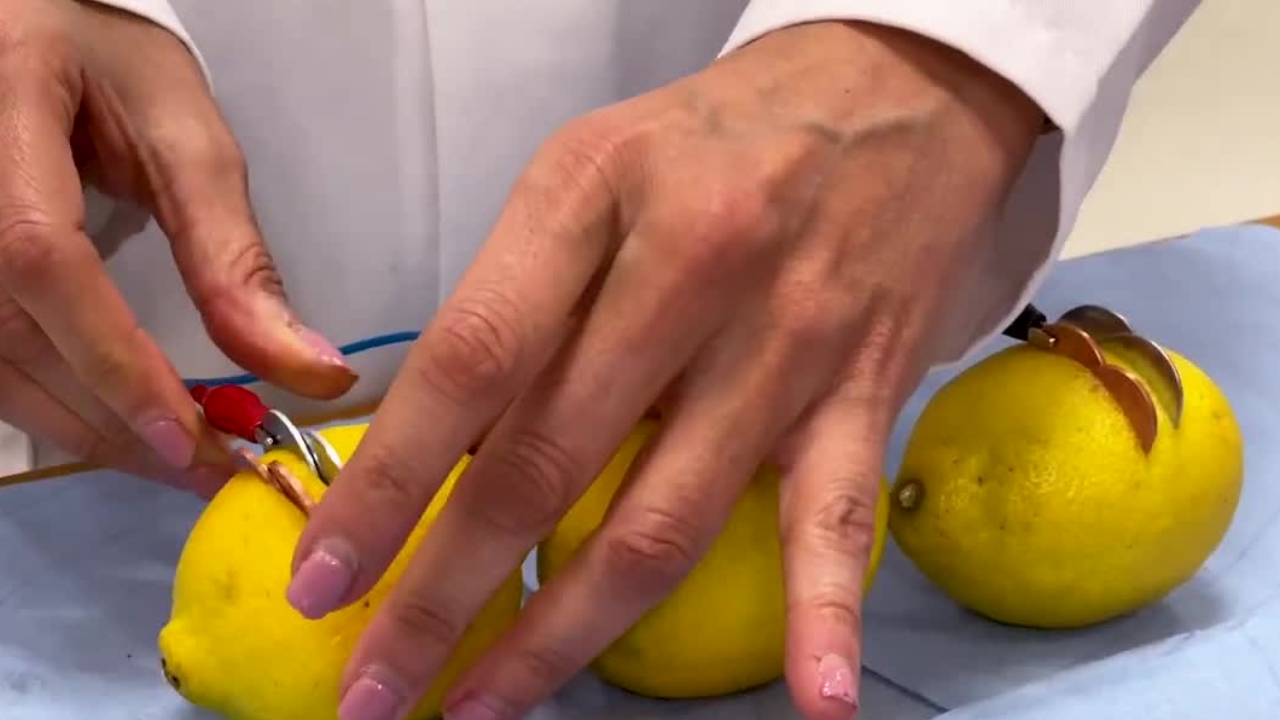
13
Step 13 of 45And you probably know that lemon juice is an acid, so we don't want it to get into your eyes.
14
Step 14 of 45In fact, today we are going to create a battery together. Did you know that a battery is actually a tiny chemical factory? I will show you the science that's inside.
15
Step 15 of 45Anyone can actually create one. How? Very simple.
16
Step 16 of 45With lemons. Isn't that amazing? The lemon battery is actually similar to the first electrical battery that was invented back in 1800 by Alessandro Volta, who used, in fact, brine, that's water with a lot of salt, instead of lemon juice.
17
Step 17 of 45We are going to find out about the type of chemical reaction, we call it oxidoreduction, that occurs inside the batteries.
18
Step 18 of 45Inside, you have two different metals that are the electrodes, it's basically zinc and copper and electrolytes, which is the lemon juice.
19
Step 19 of 45The whole idea is to create an electrical current that will flow between the two electrodes.
20
Step 20 of 45So pay close attention now and let's get into action.
21
Step 21 of 45So what are the ingredients we need to start building our battery? You need a coin cell battery here, a lithium coin cell battery with a small lead.
22
Step 22 of 45You need three lemons you can find in the grocery. You need a multimeter here to measure the voltage.
23
Step 23 of 45You need another light. You need five cents coin, which are made of copper, as you know.
24
Step 24 of 45And you need a few zinc coated washers and finally wires for the electrical connection.
25
Step 25 of 45So we have our lithium coin cell, which is small, but powerful enough to produce light from a light emitting diode.
26
Step 26 of 45Look at this. And we want to do the same with the lemon.
27
Step 27 of 45So now we'll slice the lemon. The slices must be too thin, but narrow enough.
28
Step 28 of 45Just like this. So now let's take the coins to produce the cathode of the cell and insert two coins into one side and they need to touch each other's.
29
Step 29 of 45And then our washers, which I'm going to insert in the second slice like this.
30
Step 30 of 45The metals, as you can see, need to be close to each other in order for the necessary electrochemical reaction to take place.
31
Step 31 of 45So let's now measure the voltage that our battery generates with this multimeter.
32
Step 32 of 45Let me do it. And you can see here on the multimeter that it's about one volt.
33
Step 33 of 45This is not enough to produce light from our lead. So we need to duplicate the experiments with the other, in fact, two lemons we prepared so that we can reach three volts.
34
Step 34 of 45So now, in fact, we can connect the three batteries to have an electrical series and we'll connect the cathode of the first battery with the anode of the second battery.
35
Step 35 of 45And here we go. Let me show you here.
36
Step 36 of 45Here we are. So we connected the three lemons. And finally, you can connect the light with the battery that we just produced.
37
Step 37 of 45Let's see how it works. You connect the cables here, the wires with our battery.
38
Step 38 of 45And as you can see, the lead is on. So our experiment is successful.
39
Step 39 of 45The voltage of the battery is now close to three volts. That's how much we need to produce light from LED.
40
Step 40 of 45So we've created a battery together. You can do it too. I hope you enjoyed it.
41
Step 41 of 45In fact, we need more batteries and we need better chemistry to help us not only meet the rising demand for clean mobility, for example, but also to be more sustainable to help combat climate change, an urgent challenge for our planet and future generations.
42
Step 42 of 45The answers rely in science, in chemistry.
43
Step 43 of 45Thanks to chemistry, we can innovate. We can continue to progress beyond.
44
Step 44 of 45So I hope you enjoyed it. As you can see, it's not very complicated.
45
Step 45 of 45And now it's your turn. Do it, but do it safely. Thank you.