
Knowby
Chemical Risk Assessment
Chemical risk assessments help ensure hazardous substances are managed safely to protect workers and the environment. This guide outlines how to complete a chemical risk assessment in Myosh using information from the Safety Data Sheet (SDS).
1
Step 1 of 10
<p>Complete a chemical risk assessment before introducing a hazardous substance and whenever an incident or change occurs (e.g. storage or process changes). Assess potential risks to worker health and the environment, verify existing controls are effective, and identify any additional controls required. Consult with HSRs and workers familiar with the task or process.</p>

Complete a chemical risk assessment before introducing a hazardous substance and whenever an incident or change occurs (e.g. storage or process changes). Assess potential risks to worker health and the environment, verify existing controls are effective, and identify any additional controls required. Consult with HSRs and workers familiar with the task or process.

2
Step 2 of 10
<p>Myosh is the system used for performing risk assessments. Navigate to the&nbsp;Chemical Register module. Confirm you are assessing the correct chemical and SDS revision. Review the product name, manufacturer and issue date of the SDS before commencing the assessment.</p><blockquote><p><strong>Refer:</strong>&nbsp;<a target="_blank" rel="noopener noreferrer nofollow" class="e-rte-anchor" href="https://knowby.pro/view/9b355a1f-d3d1-4fa2-9702-9843f18530d0" title="https://knowby.pro/view/9b355a1f-d3d1-4fa2-9702-9843f18530d0">Myosh Chemical Register</a></p></blockquote><p></p>

Myosh is the system used for performing risk assessments. Navigate to the Chemical Register module. Confirm you are assessing the correct chemical and SDS revision. Review the product name, manufacturer and issue date of the SDS before commencing the assessment.

Refer: Myosh Chemical Register

3
Step 3 of 10
<p>Consult the Safety Data Sheet (SDS) for both health and environmental hazard information. Identify hazards to workers and the environment.</p><blockquote><p><strong>Refer:&nbsp;</strong><a target="_blank" rel="noopener noreferrer nofollow" class="e-rte-anchor" href="https://knowby.pro/view/7dfaf065-f8dc-47be-893f-cd830c9d39a0" title="https://knowby.pro/view/7dfaf065-f8dc-47be-893f-cd830c9d39a0">Reading a Safety Data Sheet (SDS)</a></p></blockquote><p></p>

Consult the Safety Data Sheet (SDS) for both health and environmental hazard information. Identify hazards to workers and the environment.

Refer: Reading a Safety Data Sheet (SDS)

4
Step 4 of 10
<p>Identify health hazards and potential routes of exposure. Consider how often the chemical is used, how long workers are exposed, the quantity used, who may be exposed and how exposure may occur (inhalation, ingestion, skin, eyes).</p>

Identify health hazards and potential routes of exposure. Consider how often the chemical is used, how long workers are exposed, the quantity used, who may be exposed and how exposure may occur (inhalation, ingestion, skin, eyes).

5
Step 5 of 10
<p>Identify environmental hazards and consider potential exposure pathways caused by a spill, leak or release into stormwater, wastewater systems, soil and groundwater, air emissions or by waste generation and disposal.</p>

Identify environmental hazards and consider potential exposure pathways caused by a spill, leak or release into stormwater, wastewater systems, soil and groundwater, air emissions or by waste generation and disposal.

6
Step 6 of 10
<p>Review existing safety and environmental controls against the SDS requirements and confirm they are effective, maintained and suitable. Where SDS-recommended controls are not in place or are ineffective, document the gap and raise actions in Myosh.</p><blockquote style="background-color: var(--k-quote-bg-error);"><p><strong>Important:</strong> For all hazardous substances, evaluate and document whether a safer, lower-impact alternative chemical is available and suitable for substitution.</p></blockquote><p></p>

Review existing safety and environmental controls against the SDS requirements and confirm they are effective, maintained and suitable. Where SDS-recommended controls are not in place or are ineffective, document the gap and raise actions in Myosh.

Important: For all hazardous substances, evaluate and document whether a safer, lower-impact alternative chemical is available and suitable for substitution.

7
Step 7 of 10
<p>Based on the hazard, exposure and control assessment, determine the risk rating and required actions.</p><ul><li><p><strong>Low:</strong> No action required.</p></li><li><p><strong>Moderate:</strong> Implement and monitor actions.</p></li><li><p><strong>High:</strong> Prioritise and monitor actions.</p></li><li><p><strong>Critical:</strong> Escalate and act immediately.</p></li></ul><p></p>

Based on the hazard, exposure and control assessment, determine the risk rating and required actions.

  • Low: No action required.

  • Moderate: Implement and monitor actions.

  • High: Prioritise and monitor actions.

  • Critical: Escalate and act immediately.

8
Step 8 of 10
<p>If the evaluation identifies gaps or deficiencies, create an action plan in Myosh.</p><p>Identify all necessary resources required for implementation, assign clear responsibilities for each action item, remembering to collaborate with the action assignee to clarify action and timeframe for completion.</p><blockquote><p><strong>Refer:</strong> <a target="_blank" rel="noopener noreferrer nofollow" class="e-rte-anchor" href="https://knowby.pro/view/0d330262-cf43-468a-85ec-9de7e477e76a" title="https://knowby.pro/view/0d330262-cf43-468a-85ec-9de7e477e76a">Myosh - Actions Management</a></p></blockquote><p></p>

If the evaluation identifies gaps or deficiencies, create an action plan in Myosh.

Identify all necessary resources required for implementation, assign clear responsibilities for each action item, remembering to collaborate with the action assignee to clarify action and timeframe for completion.

Refer: Myosh - Actions Management

9
Step 9 of 10
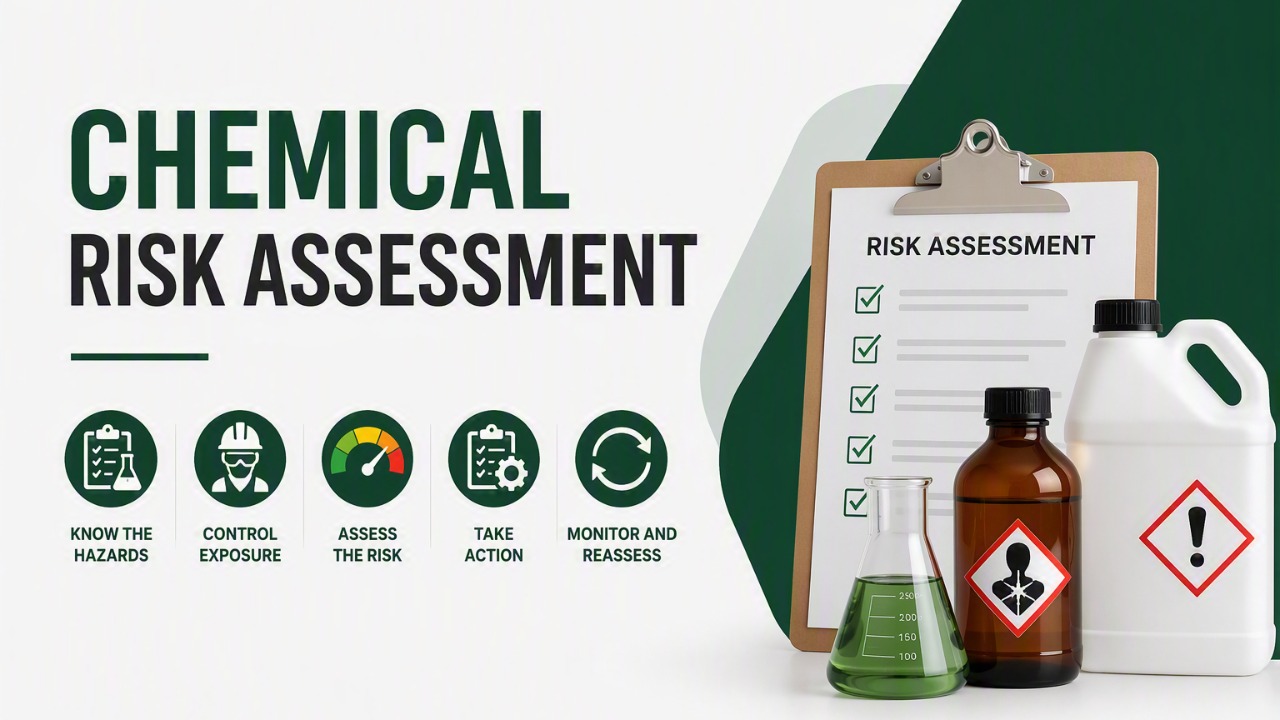
<p><strong>Know the Hazards:&nbsp;</strong>Use the SDS to understand the dangers (Sec. 1-3).</p><p><strong>Control Exposure:</strong>&nbsp;Evaluate how exposure might occur to workers or the environment and ensure existing controls are effective.</p><p><strong>Take Action:</strong>&nbsp;Determine the risk level and create an action plan to address control gaps.</p><p><strong>Monitor and Reassess:&nbsp;</strong>Regularly monitor chemicals and controls; reassess when changes occur (e.g., storage, processes).<br></p>

Know the Hazards: Use the SDS to understand the dangers (Sec. 1-3).

Control Exposure: Evaluate how exposure might occur to workers or the environment and ensure existing controls are effective.

Take Action: Determine the risk level and create an action plan to address control gaps.

Monitor and Reassess: Regularly monitor chemicals and controls; reassess when changes occur (e.g., storage, processes).