
Knowby
Chemical Awareness
This guide provides information on the safe management of chemicals in the workplace. It's designed to raise awareness, promote safe practices, and ensure compliance with regulations. This is not a substitute for specific training related to individual tasks or chemicals.
1
Step 1 of 14
<p>Hazardous chemicals are substances that can cause harm to health, property or the environment. The effects can be acute (immediate) or chronic (long-term).</p><p>They come in different forms: solids, liquids, gases, dusts,
fumes, and vapors.</p><p>Examples include cleaning products, fuels, paints, and
solvents.</p>

Hazardous chemicals are substances that can cause harm to health, property or the environment. The effects can be acute (immediate) or chronic (long-term).

They come in different forms: solids, liquids, gases, dusts, fumes, and vapors.

Examples include cleaning products, fuels, paints, and solvents.

2
Step 2 of 14
<p>Dangerous Goods (DG) are a specific category of hazardous
chemicals that present immediate physical and/or chemical hazards, such as
flammability, corrosivity, or explosiveness.</p><p>They are classified into nine classes based on their primary
hazard (e.g., explosives, flammable liquids, toxic substances).</p><p>DG are regulated under specific legislation for transport,
handling, and storage due to their higher risk profile.</p>

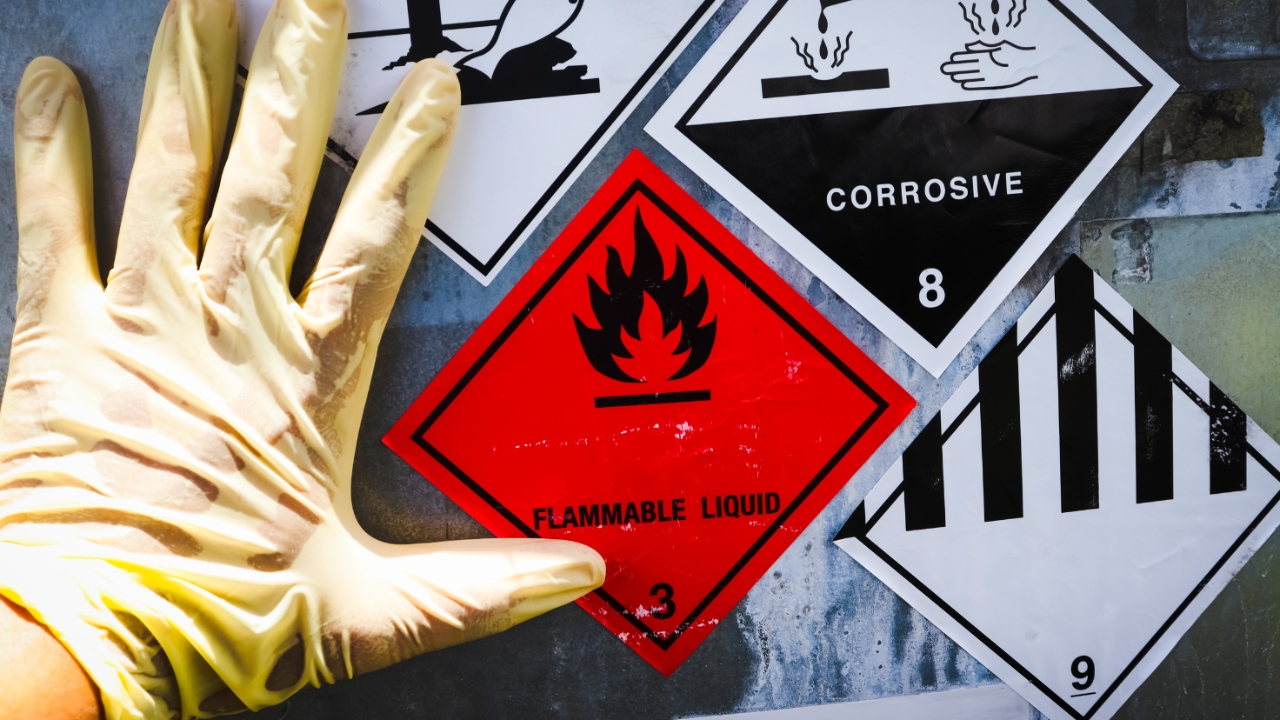
Dangerous Goods (DG) are a specific category of hazardous chemicals that present immediate physical and/or chemical hazards, such as flammability, corrosivity, or explosiveness.

They are classified into nine classes based on their primary hazard (e.g., explosives, flammable liquids, toxic substances).

DG are regulated under specific legislation for transport, handling, and storage due to their higher risk profile.

3
Step 3 of 14
<p>Myosh is our system for managing chemical information.</p><p>Chemical Register: Learn how to log into
Myosh and navigate to the Chemical Register module.</p><p>SDSs:&nbsp;Use Myosh to quickly locate the SDS for
any chemical in the workplace.</p><p>Risk Assessments:&nbsp;Myosh allows you to perform and review existing risk assessments for chemicals that are a hazardous substance or dangerous good.</p><p>Inspections: Use Myosh to check chemical storage and handling conditions are maintained in the workplace.</p><p>Incidents:&nbsp;Use Myosh to report any
chemical-related incidents or near misses.</p><blockquote><p><strong>Refer:</strong>&nbsp;<a class="e-rte-anchor" href="https://knowby.pro/view/9b355a1f-d3d1-4fa2-9702-9843f18530d0" title="https://knowby.pro/view/9b355a1f-d3d1-4fa2-9702-9843f18530d0" target="_blank" aria-label="Open in new window">myosh - Chemical Register</a></p></blockquote>

Myosh is our system for managing chemical information.

Chemical Register: Learn how to log into Myosh and navigate to the Chemical Register module.

SDSs: Use Myosh to quickly locate the SDS for any chemical in the workplace.

Risk Assessments: Myosh allows you to perform and review existing risk assessments for chemicals that are a hazardous substance or dangerous good.

Inspections: Use Myosh to check chemical storage and handling conditions are maintained in the workplace.

Incidents: Use Myosh to report any chemical-related incidents or near misses.

Refer: myosh - Chemical Register

4
Step 4 of 14
<p>Understanding the hazards associated with chemicals and the potential routes of exposure is crucial for implementing appropriate safety control measures.</p><p>Labels: Read labels carefully. They provide important
information about hazards and precautions.</p><p>Safety Data Sheets (SDS): SDSs contain detailed information
about a chemical's properties, hazards, safe storage and handling procedures. They must be readily accessible in the workplace.</p><p>Risk Assessment: Perform a risk assessment to identify hazards and required control measures.</p>

Understanding the hazards associated with chemicals and the potential routes of exposure is crucial for implementing appropriate safety control measures.

Labels: Read labels carefully. They provide important information about hazards and precautions.

Safety Data Sheets (SDS): SDSs contain detailed information about a chemical's properties, hazards, safe storage and handling procedures. They must be readily accessible in the workplace.

Risk Assessment: Perform a risk assessment to identify hazards and required control measures.

5
Step 5 of 14
<p>An SDS provides comprehensive information about a chemical substance or mixture. It's the&nbsp;primary&nbsp;source of information for safe handling, proper storage, and required emergency procedures. Chemical suppliers must provide and update SDSs every 5 years.</p><p>Key sections include: Identification, Hazards Identification,
Composition/Information on Ingredients, First-Aid Measures, Fire-Fighting
Measures, Accidental Release Measures, Handling and Storage, Exposure
Controls/Personal Protection, and Stability and Reactivity.</p>

An SDS provides comprehensive information about a chemical substance or mixture. It's the primary source of information for safe handling, proper storage, and required emergency procedures. Chemical suppliers must provide and update SDSs every 5 years.

Key sections include: Identification, Hazards Identification, Composition/Information on Ingredients, First-Aid Measures, Fire-Fighting Measures, Accidental Release Measures, Handling and Storage, Exposure Controls/Personal Protection, and Stability and Reactivity.

6
Step 6 of 14
<p>Risk assessment involves identifying potential hazards associated with chemical use, implementing controls to minimize risks, inspecting the workplace regularly to ensure conditions are maintained, and regularly reviewing and updating the assessment when changes to work tasks or the workplace occur.</p><p><span>Follow a four-step approach: 1-Enter the substance on the Chemical
Register, 2-Collect information via the SDS, 3-Assess worker exposure (type,
intensity, duration) and adequacy of current controls, 4-Rank the severity of risks &amp; create a preventative
action plan.</span><br></p>

Risk assessment involves identifying potential hazards associated with chemical use, implementing controls to minimize risks, inspecting the workplace regularly to ensure conditions are maintained, and regularly reviewing and updating the assessment when changes to work tasks or the workplace occur.

Follow a four-step approach: 1-Enter the substance on the Chemical Register, 2-Collect information via the SDS, 3-Assess worker exposure (type, intensity, duration) and adequacy of current controls, 4-Rank the severity of risks & create a preventative action plan.

7
Step 7 of 14
<p>Always consider the hierarchy of control when identifying control measures to minimize risks.</p><p>Elimination: Remove the chemical if possible.</p><p>Substitution: Replace a hazardous chemical with a safer
alternative.</p><p>Engineering Controls: Use ventilation systems or enclosed
processes.</p><p>Administrative Controls: Implement safe work procedures and
training.</p><p>Personal Protective Equipment (PPE): Wear appropriate PPE
such as gloves, goggles, or respirators.</p>

Always consider the hierarchy of control when identifying control measures to minimize risks.

Elimination: Remove the chemical if possible.

Substitution: Replace a hazardous chemical with a safer alternative.

Engineering Controls: Use ventilation systems or enclosed processes.

Administrative Controls: Implement safe work procedures and training.

Personal Protective Equipment (PPE): Wear appropriate PPE such as gloves, goggles, or respirators.

8
Step 8 of 14
<p>Store chemicals in properly labeled containers.</p><p>Keep containers closed when not in use.</p><p>Store incompatible chemicals separately.</p><p>Ensure adequate ventilation in storage areas.</p><p>Control ignition sources.</p><p>Store only the minimum volume needed.</p><p>Clean up spills immediately and according to SDS instructions.</p><p>Regularly inspect storage areas. Report issues.</p><blockquote><p><strong>Refer: </strong><a class="e-rte-anchor" href="https://content-v2.api.worksafe.vic.gov.au/sites/default/files/2018-06/ISBN-Recognising-dangerous-goods-1999-04.pdf" title="https://content-v2.api.worksafe.vic.gov.au/sites/default/files/2018-06/ISBN-Recognising-dangerous-goods-1999-04.pdf" target="_blank" aria-label="Open in new window">WorkSafe Segregation Chart</a></p></blockquote>

Store chemicals in properly labeled containers.

Keep containers closed when not in use.

Store incompatible chemicals separately.

Ensure adequate ventilation in storage areas.

Control ignition sources.

Store only the minimum volume needed.

Clean up spills immediately and according to SDS instructions.

Regularly inspect storage areas. Report issues.

Refer: WorkSafe Segregation Chart

9
Step 9 of 14
<p>Understand hazards before handling any chemical, read the SDS to understand potential hazards and perform a risk assessment.&nbsp;&nbsp;&nbsp;</p><p>Develop and implement SOPs and train workers.</p><p>Use engineering controls to minimise exposure e.g., fume hoods or ventilation systems.</p><p>Ensure proper use of Personal Protective Equipment (PPE) like gloves, eye protection, and respirators.</p><p>Practice good hygiene. Wash hands after handling chemicals and avoid eating, drinking and smoking in areas where chemicals are used or stored.</p>

Understand hazards before handling any chemical, read the SDS to understand potential hazards and perform a risk assessment.   

Develop and implement SOPs and train workers.

Use engineering controls to minimise exposure e.g., fume hoods or ventilation systems.

Ensure proper use of Personal Protective Equipment (PPE) like gloves, eye protection, and respirators.

Practice good hygiene. Wash hands after handling chemicals and avoid eating, drinking and smoking in areas where chemicals are used or stored.

10
Step 10 of 14
<p>Manifest Requirements:&nbsp;If the quantity of DG on site
exceeds specified limits, a manifest (inventory of DG) is required. This must be reported to Worksafe and the local fire brigade.</p><p>Placarding:&nbsp;Sites storing DG must display appropriate
warning signs (placards) to indicate the presence and nature of the hazards.</p><p><span>Storage Guidelines:&nbsp;DG must be stored in designated areas, following strict compatibility and quantity limits. &nbsp;Note: Moving a DG storage location requires a new Chemical risk assessment.</span></p><p>Emergency Preparedness:&nbsp;An emergency plan outlining procedures for spills, fires, or leaks involving DG is essential.</p>

Manifest Requirements: If the quantity of DG on site exceeds specified limits, a manifest (inventory of DG) is required. This must be reported to Worksafe and the local fire brigade.

Placarding: Sites storing DG must display appropriate warning signs (placards) to indicate the presence and nature of the hazards.

Storage Guidelines: DG must be stored in designated areas, following strict compatibility and quantity limits.  Note: Moving a DG storage location requires a new Chemical risk assessment.

Emergency Preparedness: An emergency plan outlining procedures for spills, fires, or leaks involving DG is essential.

11
Step 11 of 14
<p>Know the emergency procedures for chemical spills or
exposures.</p><p>Understand the location of emergency equipment (eye wash
stations, safety showers, spill kits).</p><p>Report all incidents immediately to your supervisor.</p>

Know the emergency procedures for chemical spills or exposures.

Understand the location of emergency equipment (eye wash stations, safety showers, spill kits).

Report all incidents immediately to your supervisor.

12
Step 12 of 14
<p>Regular inspections are crucial to ensure safe chemical
storage and handling. These inspections cover key areas
like labeling, storage conditions, compatibility, and spill control.</p><p>During the inspection, use the
Myosh app or web interface to complete the checklist, noting any issues and raising corrective actions where required.</p><blockquote><p><strong>Refer:</strong>&nbsp;<a class="e-rte-anchor" href="https://knowby.pro/view/16e5a096-9c84-4885-a6bd-08b0ed0c0ec6" title="https://knowby.pro/view/16e5a096-9c84-4885-a6bd-08b0ed0c0ec6" target="_blank" aria-label="Open in new window">myosh - Inspections</a></p></blockquote>

Regular inspections are crucial to ensure safe chemical storage and handling. These inspections cover key areas like labeling, storage conditions, compatibility, and spill control.

During the inspection, use the Myosh app or web interface to complete the checklist, noting any issues and raising corrective actions where required.

Refer: myosh - Inspections

13
Step 13 of 14
<p><span>Report any chemical-related
incidents in Myosh, including:</span></p><ul><li>Spills and leaks</li><li>Exposure to chemicals (inhalation, skin contact, etc.)</li><li>Observable changes to chemical composition&nbsp;<span style="background-color: unset; font-family: Roboto, &quot;Segoe UI&quot;, GeezaPro, &quot;DejaVu Serif&quot;, &quot;sans-serif&quot;, -apple-system, BlinkMacSystemFont; font-size: 20px; text-align: inherit;">(e.g., discoloration,
separation, unusual odors, pressure build-up)</span></li><li><span>Damaged or deteriorating chemical packaging (e.g., leaking
containers, bulging drums, damaged labels)</span></li><li>Any other unsafe conditions or near misses related to chemicals.</li></ul><p>Supervisors will perform an investigation and identify corrective actions.</p><blockquote><p><strong>Refer:</strong>&nbsp;<a class="e-rte-anchor" href="https://knowby.pro/view/0c985760-384a-4b7d-bf53-410532bf50fd" title="https://knowby.pro/view/0c985760-384a-4b7d-bf53-410532bf50fd" target="_blank" aria-label="Open in new window">myosh - Incident Reporting</a></p></blockquote>

Report any chemical-related incidents in Myosh, including:

  • Spills and leaks
  • Exposure to chemicals (inhalation, skin contact, etc.)
  • Observable changes to chemical composition (e.g., discoloration, separation, unusual odors, pressure build-up)
  • Damaged or deteriorating chemical packaging (e.g., leaking containers, bulging drums, damaged labels)
  • Any other unsafe conditions or near misses related to chemicals.

Supervisors will perform an investigation and identify corrective actions.

Refer: myosh - Incident Reporting

14
Step 14 of 14
<p>Know Your Chemicals:&nbsp;Understand the hazards of the
chemicals you work with by reading labels and SDSs.</p><p>Control the Risks:&nbsp;Participate in risk assessments and
use appropriate control measures (PPE, ventilation, etc.).</p><p>Handle and Store Safely:&nbsp;Follow safe handling and
storage procedures to prevent accidents.</p><p>Use Myosh: Manage chemical inventory,
SDS access, incident reporting and inspections.</p><p>Be Prepared:&nbsp;Know emergency procedures in case of a spill or exposure.</p>

Know Your Chemicals: Understand the hazards of the chemicals you work with by reading labels and SDSs.

Control the Risks: Participate in risk assessments and use appropriate control measures (PPE, ventilation, etc.).

Handle and Store Safely: Follow safe handling and storage procedures to prevent accidents.

Use Myosh: Manage chemical inventory, SDS access, incident reporting and inspections.

Be Prepared: Know emergency procedures in case of a spill or exposure.