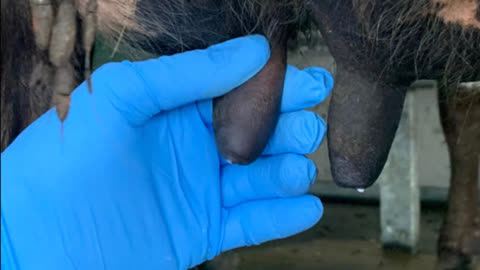
Mastitis is a costly disease on farms. There are two general types of mastitis.

COW RELATED BACTERIA Some bacteria only live in the udder. These bacteria only transfer cow to cow during the milking process. A good example of this is Staph A.
The bacteria forms an abscess in th udder which reduces milk production and makes it hard to get antibiotics into them to kill them. Because of this most treatments only settle the bacteria down and the milk returns to normal but they remain sub clinical carriers.
These cows will still shed bacteria to infect other cows and can fair up into clinical cases. Obviously it is easiest to kill the bacteria at the first infection not once an abscess is formed.

As it is spread during milking one of the control measures is to wear gloves and disinfecting them regularly. Especially if they have milk on them.

Disinfectant is best with a 70% methylated spirit mix maintaining contact for 30 seconds.
Having a dry cow program and following up the following season to ID cows that failed to cure.
If a cow fails to cure with dry cow they need culled. THIS DOESN'T HAVE TO HAPPEN IMMEDIATELY BUT A CONTOL MEASURE MUST BE PUT IN PLACE FOR THESE COWS.

THEY MUST EITHER BE DRAFTED AND MILKED LAST AFTER CLEAN COWS. OR RUN IN A SEPARATE HERD. OR CUPS CLEANED AND DISINFECTED AFTER MILKING THEM.

Some bacteria live in the environment and infect the cow via contact. This is called environmental mastitis. Strep uberis is the main bacteria here. “Think strep, think shit”!
The teat end / canal is the main defence.

Teat ends need to be keep smooth and in good condition. Overmilking, old liners and incorrect length liners cause teat end damage.

Teat spraying post milking is an important means of preventing infection post milking. The teat canal doesn’t close properly for 2 - 3 hours post milking so needs protection.
Because of this it’s important cows don’t sit down in dirty conditions during this period.

It’s equally important they don’t sit in dirty conditions pre milking when their udders are full and dripping ( again the teat canal is open ).