
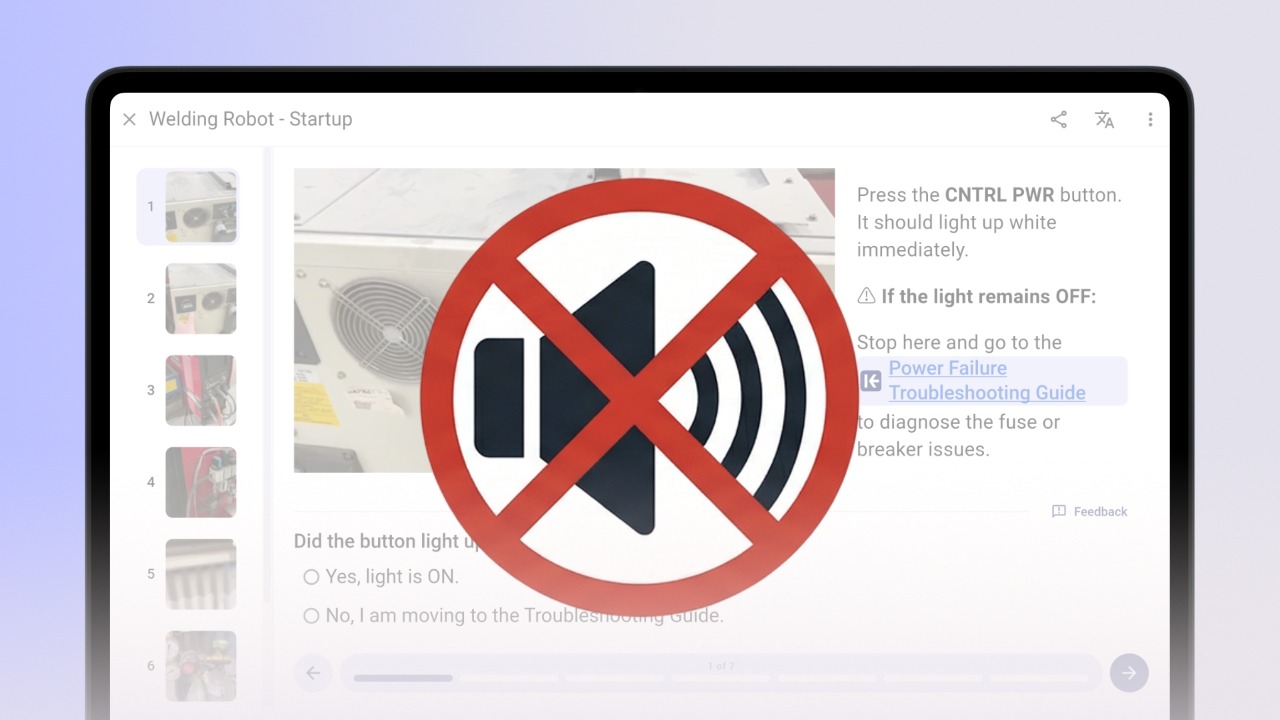

Minimizing Cognitive Overload.
Based on Cognitive Load Theory, presenting information through both complex audio and visual video can overwhelm the brain's processing capacity.
By focusing on concise text paired with short visuals, Knowby ensures the learner isn't distracted by "extra" sensory input.
Universal Accessibility via Translation.
Unlike a recorded voice, text is data that can be instantly translated into over 140 languages.
This turns a local instruction manual into a global resource without the massive cost of re-dubbing audio.
Eliminating Ambiguity.
Audio can be subjective. Background noise, poor recording quality, or heavy regional accents can lead to critical steps being misheard.
Text provides a "black and white" clarity that removes guesswork.
Leveraging OS-Level Technology.
This allows the user to listen to the instructions in their preferred voice and language using tools already optimized for their specific device.
Searchability and Scalability.
You can’t "search" a voice recording easily, but you can search text.
This makes it much faster for a user to find a specific step within a process rather than scrubbing through a video to hear a specific sentence.