
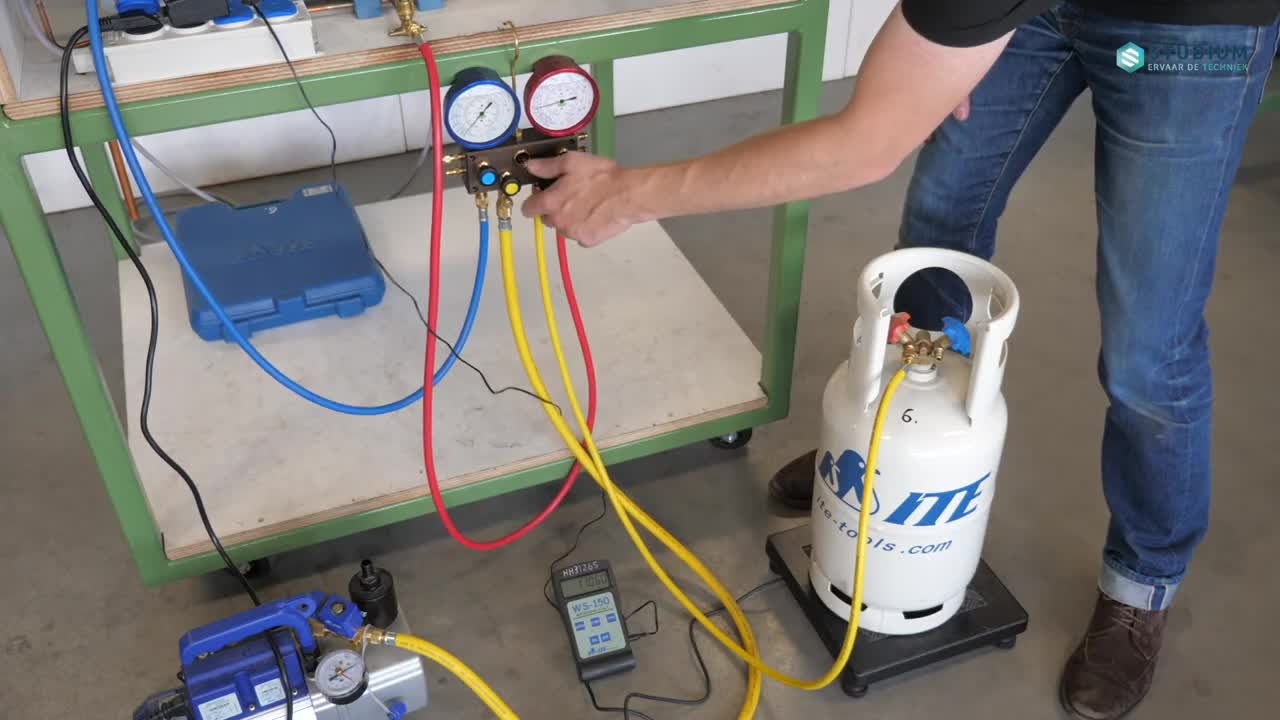
The installation has been tested and vacuumed.
Now we put the refrigerant back in the set. Here we have the following tools.
- A manifold gauge set
- A scale
- A recovery cylinder
- An electronic leak detector or sniffer
The assignment consists of three parts.
- Filling the refrigerant;
- Pumping down and disconnecting the hoses;
- Immediate leak tightness check.
Filling the refrigerant
During the vacuuming, the hose has already been taken after the recovery cylinder.
We wait until the cylinder weighs 10.2 kilograms.
Then we know for sure that there is 1.5 kilograms in the installation.
We see that the last bit from the bottle does not want to go in.
We can do that by putting it in a container with hot water. Or we use the heat gun.
Pumping down and disconnecting the hoses
The hoses are full of refrigerant.
If we were to disconnect them now, it would still result in emissions.
Vacuuming with a vacuum pump isn’t an option either, because that would release the Freon into the open air.
To work completely emission-free, we use the system’s compressor to evacuate the hoses.
We use the system’s compressor to suck the refrigerant out of the hoses.
If we leave both valves open, the refrigerant would just circulate in a loop and vacuuming would have no effect at all.
We have to close one of the closures, which is the red one.
We start with the red closure.
Then we put the black one open.
It’s the hose to the recovery cylinder — we vacuum that at the same time.
Then we carefully open the blue closure.
We open a small part of it, until all the liquid in the manifold gauge set is evaporated.
We open the blue closure carefully.
The pressure on both gauges is now equal, and we can now fully open the blue gauge.
To extract the last bit of refrigerant from the hoses, we switch off the system.
We briefly hold down the button.
Now the solenoid valve will close, triggering a pump-down, which evacuates the entire system.
You see it going down.
If it's zero, the compressor will also turn off.
Now we put the last closure on the compressor in the back-seated position.
Now the valve is back in the back-seated position.
We can remove the hose. We worked completely emission-free.
Immediate leak tightness check.
We have done an indirect leak sealing test. Next, the set is pressure-tested with nitrogen, and to be 100% sure, we perform a direct leak tightness test.
We use a cool device, an electronic leak detector or sniffer.
To make sure that the installation and the closures that we just opened are closed, we use an electronic leak searcher.