
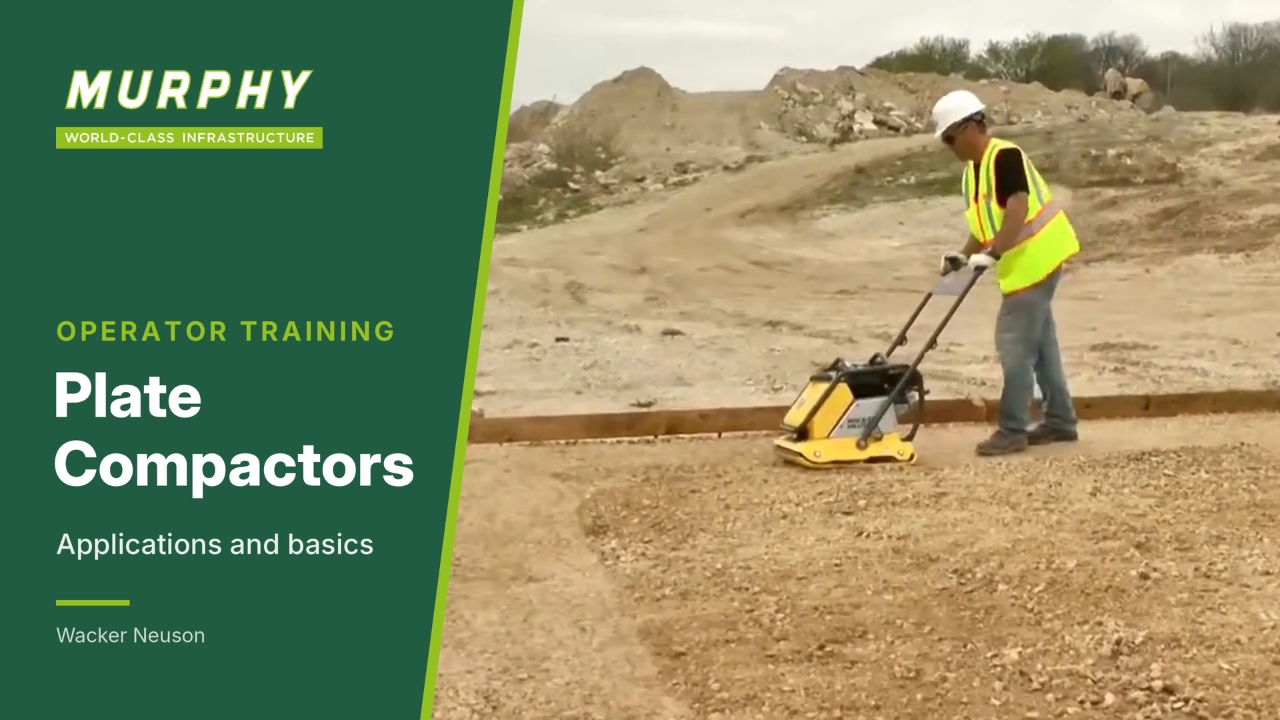
What plate compactors are for
Plate compactors are useful tools for professional contractors who prepare soils under concrete slabs or drives, for compacting asphalt, for landscape use and for do-it-yourselfers around the home.
The 220 lb (100 kg) class
Plate compactors in the 220 lb (100 kg) class are the most common size for general construction, landscaping, do-it-yourself work and asphalt compaction.
They are effective for compacting up to 8 in (20 cm) of granular material and about 4 in (10 cm) of asphalt.
Asphalt compaction
Asphalt compaction requires integral water tanks to lubricate the bottom of the base plate.
This lessens the chance of asphalt sticking and dragging.
Paving stones
Plates are often used to compact sub-base materials for paving stones, and then to set the stones into the base material by running the plate over the top.
Base compaction under concrete
Most commonly, plates are used for base compaction under nearly every concrete surface, such as floors, driveways and walkways.
Reversible plates
Reversible plates provide versatility on construction sites where extreme demands are placed on performance, efficiency and productivity.
Small to medium-sized reversible plates: compacting granular materials for load-bearing layers in street, path and car park construction, and backfill along retaining walls
Larger reversible plates: backfilling along building foundations, bridge abutments and pipeline construction
How vibration compacts the soil
Plate compactors deliver high-frequency, low-amplitude vibration energy into granular soils. This reduces friction between the particles, allowing them to settle as the plate passes over them.
The vibration frequency, expressed in vibrations per minute (VPM), energises the soil nearly 6,000 times per minute.
Use the compaction guide
Wacker Neuson's guide to soil and asphalt compaction helps with the proper operation of nearly any type of compaction equipment.
Select the type of machinery and its approximate weight.
Follow the recommendation for soil depth (lift) and the number of complete passes needed to achieve soil density at that depth.
Check that the soil is granular
Grab a handful of the soil on the job site.
Compact it into a baseball-sized lump.
Stand up and drop it from about waist height.
If it falls apart and you can see individual particles of soil, it is probably granular and suitable for a plate compactor.
Get the moisture right
Proper soil compaction depends on the correct amount of moisture in the soil.
Too dry: granular soils with low moisture content cannot bind together and produce dust clouds when plates run on the surface. It may be necessary to add water to the surface.
Too wet, or a high percentage of cohesive particles: plates begin to stick to the surface and have low travel speeds.
Just right: plates compact effectively and the surface looks like the one shown.
Read the operator's manual first
Before running any plate compactor, review the operator's manual for safety and proper operating instructions.
The clip lists the start-up points:
Check oil
Sprinkler system
Fuel
Open fuel
Choke
Starter rope
Throttle